








Why C&I BESS Sizing Starts With a Load Profile, Not a Cabinet Size
A practical way to match battery power, energy and control strategy to the needs of a European business
One of the first questions in a commercial and industrial storage project is usually: how many battery cabinets do we need? It is a reasonable question, but it comes too early. A cabinet tells us what the system can deliver. It does not tell us what the site needs.
Before choosing between 215 kWh, 261 kWh or a multi-unit configuration, the project has to begin with the customer's load profile, PV generation and operating priorities. A battery can be installed correctly and still be sized incorrectly. Too little power will not reduce the required peak, too little energy will not cover it for long enough, and an oversized system may remain partly underused.
Start with the actual site data
A monthly electricity bill gives totals, but it normally hides the shape of consumption. For a useful C&I analysis, interval data is needed, preferably at 15-minute resolution and covering a full year. This shows short peaks, long production peaks, weekday and weekend patterns, shutdown periods and seasonal changes.
If the site already has PV, or plans to install it, the solar profile must be placed beside the load profile. Annual PV generation alone is not enough. The sizing depends on when the surplus appears, how large it is and how long the battery has available to charge.
Tariffs and grid conditions complete the starting point. Peak charges, contracted-capacity rules, export limits and price spreads vary across Europe. The same factory load can therefore require a different dispatch strategy in Spain, Germany, Italy or Portugal.
kW and kWh do different jobs
Power, measured in kW, determines how much the battery can charge or discharge at one moment. Energy, measured in kWh, determines how long it can maintain that output.
For peak shaving, the power requirement is the difference between the site peak and the target grid-import limit. The energy requirement comes from the duration of that peak. A system with enough kWh but insufficient PCS power can still fail to cut the demand. A high-power system with too little energy may control the first part of the peak and then reach its SOC limit too soon.
This relationship can be seen in Risen's iCon range. The 215 kWh configurations provide 100 kW or 105 kW of rated AC power, while the 261 kWh configuration provides 125 kW. They are approximately two-hour nominal systems, although the usable duration depends on SOC reserve, efficiency, operating conditions and the selected control strategy.
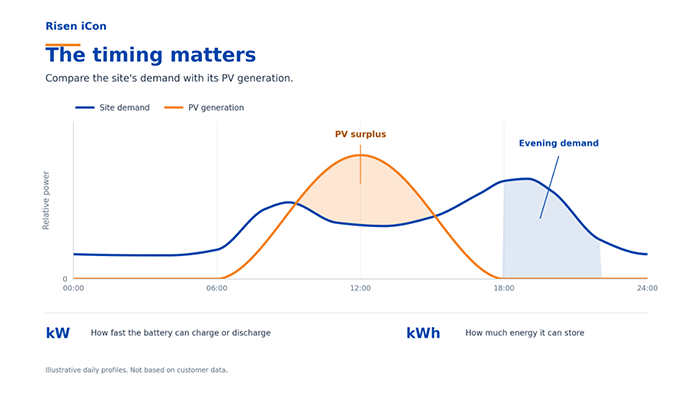
The timing and size of PV surplus and demand help determine battery power and energy capacity. Illustrative profiles.
The application changes the size
For peak shaving, the battery has to cover both the height and duration of the relevant demand peak. For PV self-consumption, it has to absorb the recurring surplus during the available charging window and move that energy into the hours when the site can use it.
Arbitrage introduces another set of conditions: price windows, expected cycles, round-trip losses and the SOC needed for other services. Backup begins with the critical-load list and required autonomy, not the total site demand. If part of the battery is reserved for an outage, that same capacity cannot be fully used for daily optimisation.
Future demand also needs to be considered. EV charging, electrified heating or a new production line can change both the peak and the load shape. Most projects combine several objectives, but the same kW, kWh and SOC cannot be assigned to all of them at the same time. The customer needs a clear order of priorities.
Applying the analysis with Risen iCon
Once the site requirement is clear, the iCon Series provides practical building blocks: 215 kWh with 100/105 kW and 261 kWh with 125 kW. A master-slave architecture allows one master cabinet to work with up to four slave cabinets in off-grid parallel operation, so the system can grow beyond one unit when the load or required autonomy is higher.
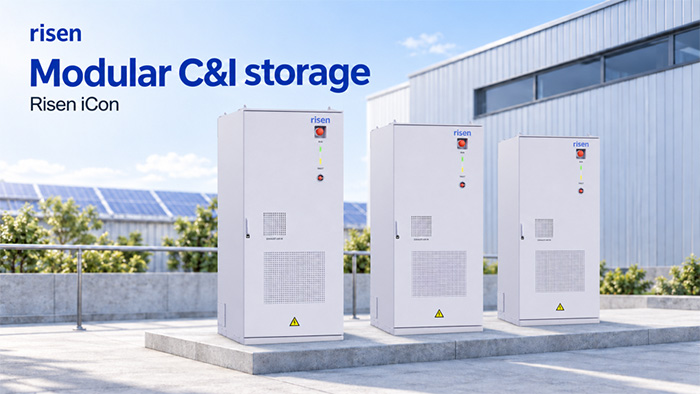
A modular iCon system can be configured around the site requirement. Concept illustration.
The iCon platform integrates LFP battery packs, PCS, BMS, EMS and liquid cooling. That reduces the number of separate interfaces to coordinate on site and lets the control strategy manage charging, discharging and SOC priorities as one system.
For outdoor installations, the iCon cabinets are rated IP55 with C4 corrosion resistance and an operating range from -30°C to 55°C, with derating above 45°C. The 215 kWh and 261 kWh systems also support on-grid and off-grid operation and black start. When automatic transfer is required, Risen provides compatible on/off-grid switching equipment, but the final backup design still has to consider site protection, critical loads and autonomy.
Sizing is also a control decision
Two sites can install the same battery capacity and obtain very different results. The difference often comes from the EMS: when the battery charges, what triggers discharge, how the peak limit is set, how much SOC is kept in reserve and what happens when two operating objectives conflict.
For this reason, the right C&I BESS does not start with a catalogue. It starts with the customer's data and a clear operating objective. The 215 kWh and 261 kWh iCon configurations can then be selected and scaled around a real requirement, with the EMS making the available power and energy work together.
Risen Energy can support customers and EPCs in Europe from the initial load-profile discussion through system configuration, integration and operating strategy.